One plantsman who’ll speak at Woody Plant Conference on July 20 transformed a remote New Zealand hillside into a world-class garden. And another, from closer to home, will suggest conifers that work for Mid-Atlantic gardens. |
Stumped by Woody Plants? Experts from Far and Near Offer Ideas
In 2000, Gordon Collier retired from one of the most famous gardens in New Zealand. Collier had spent half a lifetime creating “Titoki Point,” his five-a Visitor from all over the world admired Titoki Point, which has been described as one of the greatest plantsmen’s gardens in the world. John Pelrine, a producer for public television’s “The Victory Garden,” called it “a joy to be in,” and in 1993, its horticultural variety and artistry were captured in the book Gordon Collier’s Titoki Point.
‘Fantastic experience,’ says Scott curator
Andrew Bunting, curator at Scott Arboretum of Swarthmore College – where Collier will deliver the opening address at the Woody Plant Conference later this month – worked at Titoki Point for several months in the early ’90s, and remembers it as “a fantastic experience.” “I helped in all aspects of the garden, from garden maintenance to mowing and plant propagation,” Bunting says of his immersion in New Zealand horticulture. Not all the plants he dealt with were indigenous to that South Pacific country. “I also designed the American Garden, which featured plants native to North America.” When Collier and his wife, Annette, retired in 2000 from the family farm they had tended for decades, they left behind their fabulous garden as well, and moved to a quarter-acre property at Five Mile Bay, on the eastern shore of New Zealand’s North Island.
Building a garden from scratch…again
But did the distinguished horticulturist sit back in an easy chair and dream of the garden he’d left behind? Of course not. When he wasn’t traveling or writing, he designed another garden – and the house to go with it. Six years later, the new garden is a sight to behold, from its woody plants to the bulbs and herbaceous woodland plants. Yet he started with a bare lot on the site of an old volcano. “It’s all pumice and sand,” he said in a phone interview from the home he designed, which features a guest house joined by a glass gallery to the main house, with water gardens between the two living spaces. “I put 60 meters of soil in before we built the house. We have automatic irrigation, and it works like a charm.”
He’ll talk about Woodies from ‘Down Under’
Images from both of his gardens will rate a mention on July 20 when Collier talks about “Woody Plants Down Under: A New Zealand Perspective” at the conference at Swarthmore College. Although most of the woodies he’ll feature wouldn’t be hardy in Philadelphia’s climate, he will suggest some that should work here, such as Hypericum kouytchense, Cotinus 'Grace', Magnolia 'Vulcan', and probably some of the hydrangeas. In addition to Scott Arboretum, the Woody Plant Conference is sponsored by Chanticleer in Wayne, Longwood Gardens in Chester County, Morris Arboretum of the University of Pennsylvania in Chestnut Hill, Tyler Arboretum in Delaware County, and the Pennsylvania Horticultural Society.
Conference appeals to home gardeners, too
This annual conference is popular with home gardeners as well as horticultural professionals because it offers practical advice and design inspiration along with envy-inducing imagery from some of the world’s most beautiful gardens. Among the speakers likely to appeal to home gardeners this year are Kathryn Belville, a Master Arborist who’ll offer “Step by Step Assessment for Planting Success”; Richard Bitner, author of the just-published Conifers for Gardens: An Illustrated Encyclopedia, who will speak on “Conifers for Mid-Atlantic Gardens”; and Donald Leopold, author and faculty member of the State University of New York College of Environmental Science and Forestry, who’ll talk about “Native Trees, Shrubs, and Vines for the Garden.” Also on the agenda are A. Peter Wharton, curator of the David C. Lam Asian Garden of the University of British Columbia Botanical Garden and Centre for Plant Research in Vancouver, who will address “The Jade Garden: The Continuing Bounty of the Orient,” and Philippe de Spoelberch, vice-chairman and creator of Arboretum Wespelaar in Haacht, Belgium, who will close the conference with his lecture on “Arboretum Wespelaar: Woody Plants for Western European Parks.”
Choosing the right plant for the site
Collier, who has been associated with numerous horticultural publications and organizations – including more than 45 years with the Pukeiti Rhododendron Trust – exemplifies this approach for gardeners at any level: Put the right plant in the right place. The basic philosophy in the development of Titoki Point, he said in a 2004 issue of the New Zealand Garden Journal, was always “to plant with the site, never against it. If the wrong plants were chosen, they inevitably failed and the process started again. On the other-hand, the correct choice led to rapid growth and spaces rapidly filled up.”
Too many conifers poorly chosen, area expert says All too often, says Lancaster County’s Richard Bitne “Conifers are too often thought of as ‘foundation’ plants,” says Bitner, “a spiky one at the corner and a row of buns along the front, perhaps with an Asian azalea mixed in. Or they serve as a single specimen plant in the middle of the front or back yard. “They are also, all too often, poorly placed – that is, they are planted too close to the house or driveway or path – and they outgrow their space. The homeowner is then unhappy with them, and is forced to hack away … causing them to lose their grace.” But Bitner, whose Conifers for Gardens: An Illustrated Encyclopedia was published by Timber Press in spring, hopes to change that.
Conifers can provide structure, texture, even fall color
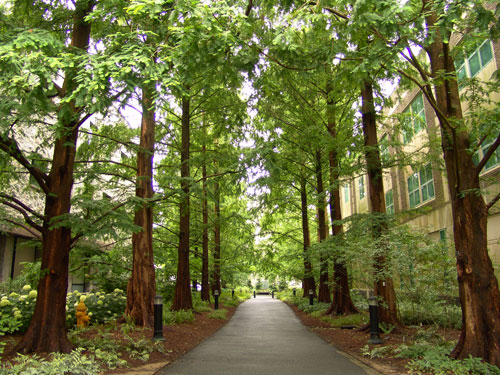
“Conifers are more than foundation plants and holiday trees,” says Bitner, who’ll talk about “Conifers for Mid-Atlantic Gardens” at the Woody Plant Conference. “They provide structure to our mixed borders. They offer color variation – there are conifers with leaves that are gray, silver, yellow, bluish, or gold-, white- and cream-variegated – and textural contrast – some are sharp or spiny, some can be fondled, and some, the deciduous ones, are even ferny. “And yes, there are deciduous conifers, cone-bearing trees that lose their leaves each year, such as larches, dawn redwoods, and bald cypresses. These generally provide striking fall color in the garden.”
Check this list before you make your choice
Before you add any conifers to your garden, however, check out a few things about the spot you’ve chosen and the variety of tree you’re considering. For instance:
When loving a tree simply isn't enough
Falling in love with a tree such as the Colorado Blue Spruce is not sufficient reason to plant it. This selection has never done well in our hot summers, and doesn’t age well. “A better choice for that ‘blue conifer effect’ is the native Concolor Fir (Abies concolor),” says Bitner, who grows this conifer, among others, in what he calls “a chaotic country garden” that he shares with two Beagles and a Bouvier in Lancaster County. He also likes the dark green Nordmann fir for this area, or the Korean fir (Abies koreana ‘Silberlocke’). “This one is silver-ish – a stunning plant that also has purple upright cones in the spring,” he adds. He also grows the Oriental spruce (Picea orientalis), which he considers the best spruce for this area, because it does well in our summers and has no common pests or diseases – and it has beautiful red pollen-bearing cones in the spring.
Small garden? That's why there are dwarf selections But don’t try to grow a tree that’s destined to be large in a space that definitely is not. “Virtually every genus of conifers has dwarf or slow-growing selections available,” he points out, so a gardener can still enjoy the features of a particular variety without worrying that it will shade out the whole garden in a decade. “This is particularly true of a species like the Norway Spruce, and the pines and false cypresses. There is even a dwarf selection of bald cypress,” called Taxodium distichum ‘Peve Minaret,’ which is ideal for a small garden and turns a dusty red in fall. It’s often not easy to find a nursery that stocks more than the usual junipers, white pines, and arborvitae, Bitner admits, but it’s worth the search. And you can begin by visiting area arboreta to see which conifers you like best. (His encyclopedia lists some regional public gardens that are well worth a visit.)
Beginning a love affair with horticulture
Bitner, who teaches clinical anesthesiology at Hershey Medical Center, began his love affair with horticulture by chance, after he bought an old dairy farm in 1980. “I was floundering, digging up multi-flora rose and bittersweet for 10 years,” he recalls. “I realized I had to know more, so in 1990 I started studying at Longwood, and it changed my life.” He worked his way straight through both Certificate courses that Longwood Gardens offers – a four-year commitment – and was promptly invited to become a plant walk instructor with the display garden’s education department. He later became a course instructor for Conifers and Deciduous Flowering Shrubs II, and has now added “author” to his achievements.
Writing is a solitary undertaking
He traveled to several countries to shoot photographs for the conifer encyclopedia – he took all 1550 color photos in the book – and spent months writing it. “It’s a solitary endeavor, and you have to have the disposition for that,” he says. Obviously, he does. “I loved it,” he says of the experience. And he hopes to do it again – with another plant book. Want to attend the conference? Here's how...
|
|||


cre garden near Taihape on the North Island, transforming a remote hillside into a showcase of spectacular flora and design excellence, with dramatic vistas and masses of rhododendrons.
r, American gardeners fail to put the right conifer in the right place.